


Contents
Ready to simplify, scale, and grow?
Subscribe to get the latest workforce management and payroll news in your inbox.
Payday Super is a new Australian law requiring employers to pay employees their superannuation entitlements on the same day as their regular pay. The new legislation aims to improve retirement outcomes for Australian workers.
Many employers will need to increase the number of superannuation payments they make. The existing requirement is to pay super quarterly. However, payments will now need to be made at the same time as wages or salary. The Federal Government’s Payday Super legislation passed both houses of parliament on November 4, 2025 and will come into effect on July 1, 2026. That means it's time to review your payroll systems and lighten the workload each pay cycle.
What is payday super?
In Australia, employees are entitled to a Super Guarantee (SG). Under this scheme, employers are required by law to contribute a percentage of their employees' ordinary time earnings into an employee’s superannuation fund of choice.
When the new payday super legislation commences, the following requirements will also need to be met:
- Super guarantee payments must be paid to an employees’ super fund at the same time as paying qualifying earnings (QE), on payday, and received by the super fund within 7 business days.
- There are some exceptions to the 7-day deadline, such as for new employees.
- If the funds are late, employers will be liable for the new super guarantee charge (SGC), which includes tougher penalties if super is not paid in full and on time.
- Qualifying earnings and super liability will both need to be reported through STP.
- The ATO Small Business Super Clearing House (SBSCH) will also be closed for all employers.
Businesses that aren’t paying their employees’ contributions in alignment with their pay cycle currently will need to update their systems and processes. You can learn more about the new requirements via the Australian Tax Office’s official guidance.
Why was Payday Super proposed?
Australia’s superannuation was created to help working Australians have a secure retirement. The goal was to help people save for their retirement, reduce reliance on the Age Pension, and improve people’s standard of living when they finish work. It became compulsory for employers to pay in 1992 and has undergone a number of changes to create better outcomes for Australians. The latest iteration is the new Payday Super legislation.
By making superannuation contributions more frequent, Australian workers have more potential to generate earnings and can retire with increased balances. Payday Super is also being introduced as the Australian Tax Office (ATO) develops more sophisticated methods for identifying compliance breaches.
According to the ATO’s annual report, Australian workers missed out on $5.2 billion of unpaid superannuation in 2023-24, up from $4.8 billion in the previous financial year. While the total amount increased, the percentage of super that went unpaid after recovery efforts dropped from 6.7% to 6.3% thanks to new measures for calculating unpaid super and increased compliance action.
Beyond maximising the value of employee superannuation, more frequent contributions have plenty of other benefits:
- They make it easier for employees to monitor if their super entitlements are being met.
- They encourage higher retirement savings and living standards in Australia.
- Employees will be able to review their superannuation account transactions each pay cycle to check for non-compliance.
- They reduce the risk of employers building up large superannuation liabilities that they may end up being unable to pay by the end of the quarter.
- Non-payment and underpayment of superannuation is considered wage theft. The increased frequency will help employers avoid significant fines and penalties for non-compliance that can occur with quarterly contributions.
- The Australian Tax Office will be able to match Single Touch Payroll (STP) data and superannuation fund reporting, gaining more visibility of SG contributions throughout Australia.
- They enable the Australian Tax Office to identify unpaid superannuation earlier and take quick action.
How will Payday Super changes affect employers?
Many employers will need to adjust their payroll processes to adapt to the new Payday Super legislation.
Employers paying super on a quarterly basis may struggle with the additional workload. The increased frequency of payments could also be challenging for those with high employee turnover, shift-based workers, and short pay cycles. Businesses with variable cash flow could also find it challenging to meet, as less frequent payments give them more time to build up their funds.
As payments are made more often, payroll systems need to be able to provide feedback on payment issues so that every transaction is completed on time.
Without updating their technology, many payroll departments would need more employees to handle the increased workload. However, with a seamless payroll system in place, paying super funds on every payday can help employers monitor their cash flow, stay on top of their obligations, and avoid fines for non-compliance.
Preparing for payday super
You may wish to integrate Payday Super into your payroll systems earlier than July 1, 2026, so you’re ready to go well before the requirement starts. To prepare for payday super, you should:
- Assess your current processes and find opportunities to embed super into your payroll.
- Communicate and outline the transition to payday super with employees, addressing any questions or concerns.
- Seek advice from HR and IR experts to ensure compliance and a smooth implementation.
You can also watch our on-demand Payday Super webinar featuring Matt Wynn, Chief Product Officer of foundU and Paul Mills, Tax and Superannuation Consultant at Citation Legal. In this session, Paul Mills explains the legal implications for your business and Matt Wynn provides a breakdown of how the foundU platform will be ready to handle the changes and steps customers can take to get ready now.
How technology can streamline Payday Super management
Many employers have a manual process for paying super. New staff often choose a super fund via a paper-based standard choice form, and the information is entered into payroll manually. When it’s time to pay super, employers might extract a file from payroll and load the information into a super fund portal. STP reporting may then be completed separately after all of these steps.
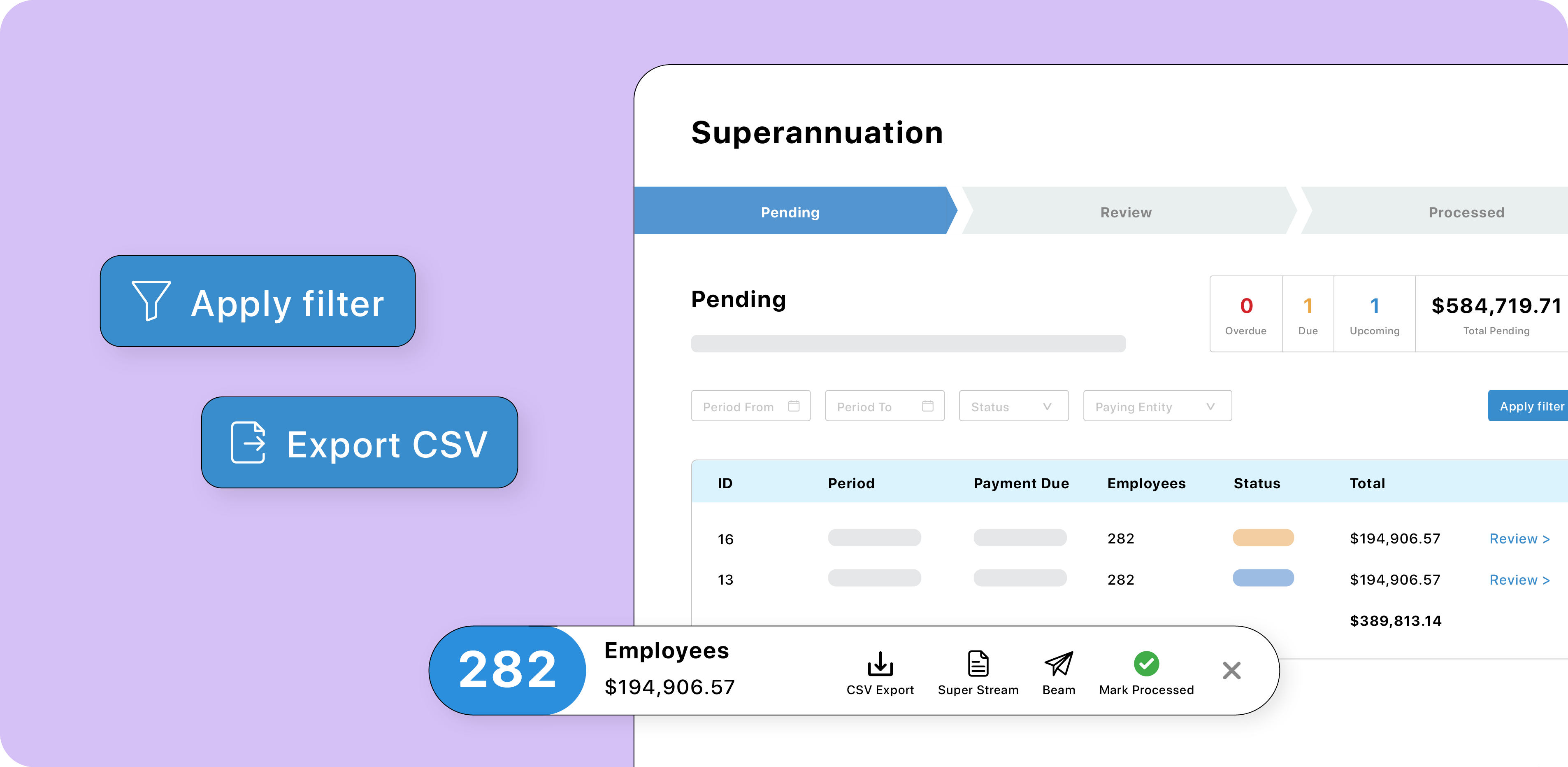
However, if you use foundU's payroll software, you can already pay super with every pay cycle or at a cadence that suits your business. You can also:
- Easily capture every employee’s chosen super fund via digital employee onboarding.
- Send information about worked shifts, time, and attendance to payroll via native rostering software so you can track wages and super obligations in real time.
- Automatically send all employee payroll data, including salaries, wages, PAYG withholdings, and superannuation to the ATO each pay cycle via our seamless STP reporting.
- Easily accrue, track, and report your superannuation liabilities in detail, and catch errors before submission.
- Choose to make fast and secure super payments via our integration partner, Beam.
- Remove the need for data exports and files.
- Validate payroll and data accuracy in real time.
How foundU is prepared for Payday Super
Once you have a combined payroll and super system, you can save time, pay with precision, and reduce room for error. foundU will also be delivering new updates, well in advance of July 1, 2026, so you know exactly how much you need to pay and when. You'll also be able to get it done in a few clicks!
We don't have to rebuild the system and are simply adding a compliance layer to help you meet the requirements. Here's what we're rolling out:
- Error notifications and batching to support correct processing from July 1.
- STP reporting updates to include both qualifying earnings and superannuation liability.
- Automatic pay item mapping to the correct QE categories.
- Automated stapling lookups during onboarding.
- Enhanced error handling and validation during approvals and employee changes, reducing the risk of pay bounce backs and super payment errors.
- QE day batching allowing customers to process super payments in line with new requirements.
If you want to see how our customers are preparing, check out our Payday Super checklist and timeline.
Super should be a native or integrated component in payroll
We understand that it can be hard to keep up with new legislation. However, we do expect that Australia’s superannuation system will continue evolving.
The good news is that there are many ways you can simplify and speed up your payroll processes. By adopting payroll automation, you can meet future requirements with ease.
If you want to learn more about how you can meet the upcoming payday super requirements, then book a demo of foundU. We can show you our easy-to-use payroll platform and seamless superannuation solutions.